
The independent blockchain combines a 21-million-coin supply limit with shielded transactions, alternative mining rewards and cryptographic mechanisms designed to address emerging quantum-computing threats.
[City, Country — November 28, 2026] GENORYN Krypton, an independent blockchain network launched on November 3, 2026, is bringing together several developing areas of cryptocurrency infrastructure, including fixed monetary supply, transaction privacy and post-quantum cryptography. Its native currency, GNR, follows a Bitcoin-inspired supply model, while its underlying network introduces different mechanisms for transaction authorization, mining rewards and cross-chain exchanges.
The project enters an industry where blockchain developers continue to examine how digital currencies can maintain transparent monetary rules while addressing changing security requirements and user expectations around financial privacy. GENORYN’s published architecture presents Krypton as an independent network rather than a Bitcoin derivative or a token operating on an existing blockchain.
A Fixed Supply Model With Independent Network Rules
According to GENORYN’s official documentation, Krypton has a maximum supply of 21 million GNR. Its monetary schedule establishes an initial block subsidy of 5 GNR, with a target block interval of 60 seconds. The subsidy is programmed to halve after every 2.1 million blocks.
The project states that the Krypton genesis block issued no coins and that the network has no premine or developer allocation. Its mainnet became operational on November 3, 2026.
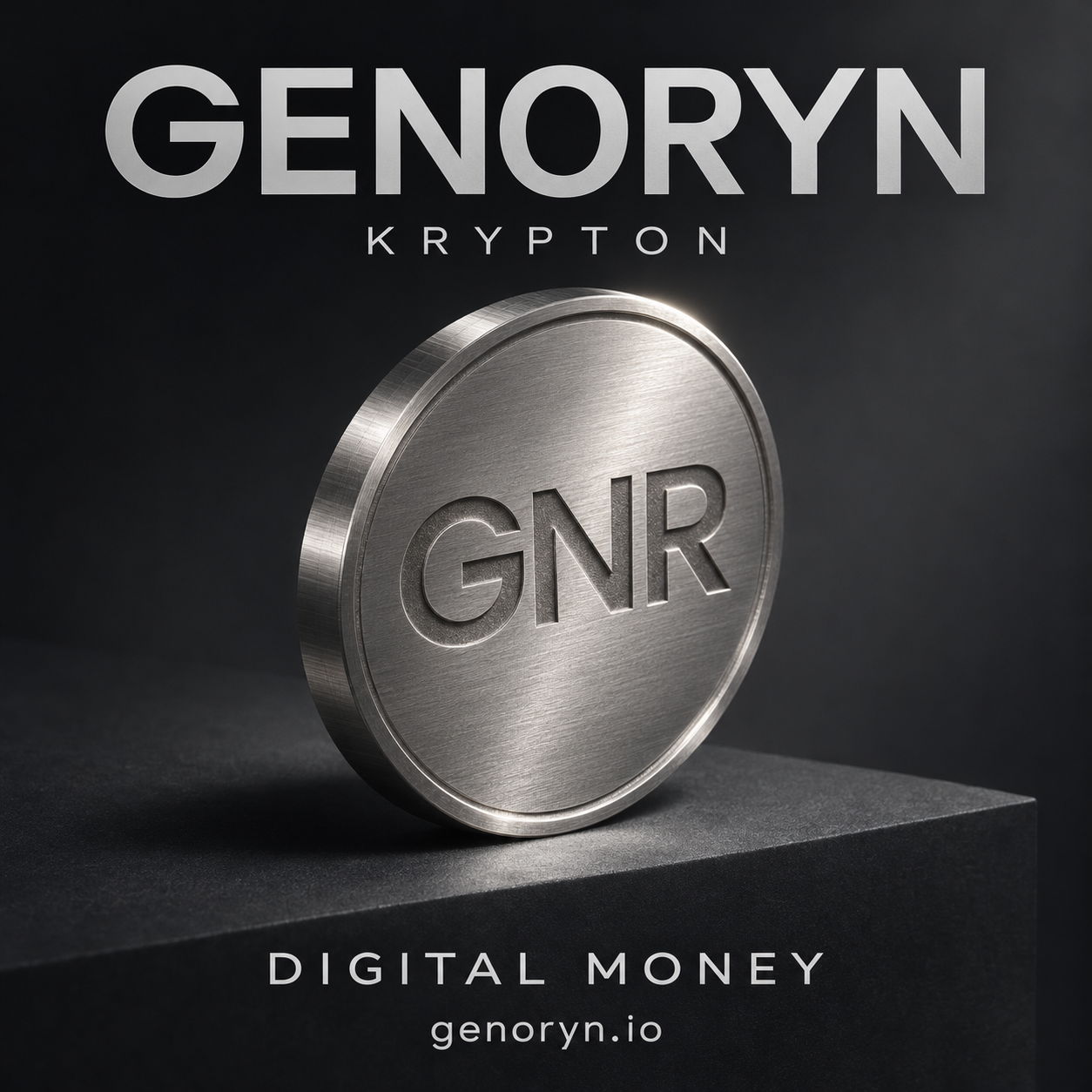
Although the supply ceiling resembles Bitcoin’s monetary limit, Krypton operates through its own codebase and consensus rules. The project’s repository also distinguishes the new network from its earlier GENORYN Mainnet 1.0, stating that previous-network balances were not migrated to Krypton.
A fixed supply schedule provides predictability regarding issuance, but it does not independently establish market demand or monetary value. Network adoption, transaction activity, liquidity and user confidence remain separate considerations when evaluating a cryptocurrency’s economic prospects.
Cryptographic Design Addresses Future Security Concerns
A defining element of Krypton’s technical proposition is its approach to cryptographic security. Conventional cryptocurrency systems commonly use elliptic-curve cryptography for transaction authorization. Bitcoin, for example, supports Schnorr signatures through the mechanism documented in Bitcoin Improvement Proposal 340.
GENORYN’s security documentation describes a different approach based on hash-based zero-knowledge STARK proofs. These proofs allow the network to verify that spending operations satisfy protocol requirements without publicly revealing the underlying private payment information.
The project also describes payment-data encryption combining X25519 with ML-KEM-1024. ML-KEM is a key-encapsulation mechanism standardized by the US National Institute of Standards and Technology under Federal Information Processing Standards Publication 203 (FIPS 203) in August 2024.
NIST developed the standard as part of its post-quantum cryptography work. It is intended to establish shared encryption keys using a mechanism designed to resist attacks from sufficiently capable quantum computers.
The distinction between adopting a standardized cryptographic component and securing an entire blockchain is important. The overall security of a network depends on implementation quality, wallet software, key management, consensus rules and the integration of different cryptographic systems. NIST’s standardization of ML-KEM does not represent certification or endorsement of GENORYN Krypton.
Transaction Privacy Incorporated Into the Network
Krypton’s privacy architecture is designed to make shielded payments part of ordinary transaction processing rather than an optional feature.
According to its published privacy model, the network conceals sender and recipient identities and transaction amounts through cryptographic commitments and zero-knowledge proofs. This allows transaction validity to be checked without requiring public disclosure of the underlying payment details.
However, the system does not make every aspect of network activity invisible. Transaction occurrence, timing, fees and specified network-level information remain observable. Mining shares and rewards are also publicly verifiable.
External transactions require separate consideration. Bitcoin payments associated with BTC–GNR swaps remain visible on Bitcoin’s public blockchain. GENORYN’s documentation also describes reporting completed swaps to its offer board with relevant amounts and Bitcoin contracts.
These distinctions are important when assessing the scope of blockchain privacy. Shielding payment information on one network does not automatically guarantee anonymity across external services, internet connections or trading relationships.
Mining Rewards and Bitcoin Interoperability
Krypton uses KryptoHash, a proof-of-work algorithm supporting both graphics processing units and central processing units. Its mining guide describes a protocol-level reward-sharing mechanism through which participants receive proportional allocations based on submitted computational work.
The arrangement is intended to reduce dependence on conventional external mining pool operators. Rewards accrue before periodic payouts at intervals of 360 blocks, approximately six hours under the target block schedule. A separate 100-block maturity period applies before rewards become spendable.
The model changes reward coordination but does not independently guarantee decentralized mining. Hardware ownership, electricity costs and the distribution of computational resources remain important factors.
The network also supports atomic swaps between Bitcoin and GNR. Its documentation describes cryptographic locks and timeouts that allow users to exchange assets directly without first depositing them with a custodial exchange. The mechanism provides a trading method, although liquidity and counterparty availability are not guaranteed.
Security Assessment and Future Considerations
GENORYN publishes its source code and reports internal security reviews and software fixes. Its repository describes an internal, AI-assisted review dated November 5, 2026, covering version 1.0.6, with reported software fixes in version 1.0.7.
The project explicitly states that this review does not replace a full independent audit by a specialized security firm. Its documentation identifies the original STARK spending circuit, zero-knowledge masking and consensus code as areas requiring further independent scrutiny.
For Krypton, the next stage will involve demonstrating how its architecture performs under sustained network participation and independent technical examination. Mining distribution, software reliability, transaction activity and market liquidity will all contribute to assessing its longer-term development.
About GENORYN Krypton
GENORYN Krypton is an independent proof-of-work blockchain with a native cryptocurrency, GNR, and a maximum supply of 21 million coins. Its architecture includes KryptoHash mining, shielded transactions, hash-based zero-knowledge STARK proofs, hybrid encryption using ML-KEM-1024 and X25519, and Bitcoin–GNR atomic swaps. Further information and technical documentation are available at https://genoryn.io/.


