
Start with the summer routine your household already has
An outdoor TV is worth considering for Australian households that already enjoy spending time outside, have a shared reason to watch there and can provide a suitable permanent setup. It is a weaker fit when nobody really wants another viewing area, the only available position is unsuitable, or buying the screen would leave too little money for comfortable seating and necessary installation.
Start with the occasions you can name. A household that regularly watches afternoon matches has a different reason to buy from one that wants a film after dinner. A third household may only want to glance at the score while friends chat over a BBQ. All three uses can involve a television, but they ask different things of the space.
Watching a whole match or film means settling into seats with a useful view and sound people can follow. Occasional score-checking may not justify arranging the entire alfresco around a screen. Ask whether the TV would support an activity people already enjoy or turn a flexible outdoor area into somewhere they feel expected to watch.
There is no universal number of viewing sessions that makes the purchase worthwhile. Consider ordinary evenings and weekends as well as the big gathering you have in mind. If nobody can describe when the screen would be used after that event, keeping the existing indoor arrangement is a reasonable choice.
A shared preference matters, too. Someone who wants cricket in the afternoon and someone who values a quiet dinner outdoors do not necessarily disagree about the equipment. They may need to agree on when it will be on. Resolve that before turning the discussion into a contest over screen size.
Make room for viewing without taking over the outdoor space
Households with an established, comfortable seating area are better placed to add a fixed screen than those still deciding how the backyard will work. The television should fit the activities already planned for the area, including the times when nobody is watching.
Consider this planning example: one family has a lounge area facing a possible TV wall, with a separate route between the BBQ and dining table. Another has only a narrow passage beside the table, and adding viewing seats would obstruct the route. Both families might enjoy outdoor films, but the second has a layout decision to make before an equipment decision.
Try the arrangement with the furniture you intend to use. Sit where a whole film would be watched, pull the dining chairs out and walk the usual route to serve food. If watching requires people to twist towards the screen or repeatedly move out of someone’s way, reconsider the position or seating.
Think about the screen when it is off. Would its position still leave room for conversation, meals and the parts of the garden the household values? A family that prefers an outdoor space without a permanent screen can keep watching indoors without treating that as a compromise to be corrected.
For renters, households likely to move and people using shared property, establish what changes can be made before committing to a fixed installation. Discuss permission, removal and the effect on the property with the relevant owner or manager. These are planning questions; the answers depend on the property and arrangements involved.
A renter who expects to move soon needs a different decision from an owner staying through a planned renovation. The renter’s question is whether the permitted arrangement remains worthwhile over the time available, including removal. The owner’s question is whether the current plans are settled enough to avoid committing to the wrong position. Both may have enthusiastic viewers; neither is made ready simply by that enthusiasm.
Check whether a suitable installation is achievable
A household can have a clear viewing need and still need to postpone the purchase while the installation is planned. A usable position requires more than an empty wall: consider the support, exposure, seats, power, connections and access for future servicing.
As a local example, Sylvox’s Australian selection guide separates “Full Sun (Direct Sunlight)” from “Partial Sun / Covered Alfresco”. The brand describes the first category for open areas exposed to direct sunlight for most of the day, and the second for covered patios, alfresco areas and outdoor spaces with some shade. Those categories provide a starting point for choosing within its range.
Apply that distinction to the intended screen position, rather than the name given to the whole backyard. The wall beneath a roof and an open position beside it can present different conditions. For daytime viewing, consider direct sunlight at the screen separately from reflections off nearby surfaces; a seating change and a screen-position change solve different problems.
The household’s viewing schedule helps determine the value of the purchase. It does not remove the conditions a fixed television must withstand between viewing sessions. A family that mainly watches films after dark still needs a model and installation suitable for the location where it will remain during the day.
Avoid assuming that a brighter screen settles every suitability question. Start with the chosen model’s permitted installation conditions, then consider whether its picture will serve the intended viewing times. Equally, do not assume that putting an indoor television under a roof establishes that its manufacturer permits that use.
Where support, mounting or electrical work is needed, involve appropriately qualified professionals. Give them the proposed television’s details, intended location and access requirements before ordering. If the workable location depends on an unfinished wall, new power or another part of a renovation, settle the scope and sequence of that work first.
Include the cost and effort of keeping the setup usable
The purchase is a better fit when the household can fund the complete viewing arrangement and is comfortable with operating it. A screen that fits the shopping budget can still be premature if the necessary installation and connections have no budget of their own.
Separate the television from the work and equipment needed to start watching. Depending on the plan, that may include a suitable mount, professional installation, power or connection work, delivery and a playback device. Identify what is included in the chosen package and what existing equipment is genuinely suitable before paying for accessories twice.
Allow for the services you actually intend to use. If sport or films require a subscription, include that ongoing expense in the household decision. Having a smart television does not, by itself, settle whether a particular Australian service, device and account will provide the programmes you want. Establish a supported playback route for those programmes before buying around them.
Sound equipment is a separate choice. Consider whether commentary and dialogue can be heard from the planned seats without an uncomfortable volume for others nearby. Closer seating or a different arrangement may deserve attention before an additional speaker purchase. Do not make a soundbar a compulsory part of the budget simply because it appears in a bundle.
Then consider who will operate the setup. If only one person knows how to select the source, start the programme and adjust the picture or sound, would everyone else still use it? Ask for a demonstration of the relevant controls on a shortlisted model. Ease of starting an ordinary viewing session can matter more than another feature nobody expects to use.
Also allow for the selected model’s care requirements and access to its connections. Decide where controls will be kept and how any equipment requiring storage will be handled. For a household that wants very little additional upkeep, these practical tasks belong in the purchase decision, alongside the attraction of watching outdoors.
Make the routine responsibilities a household decision as well. Who will keep the controls accessible, maintain any subscriptions and carry out the care the chosen model requires? There is no need to assign every task in advance, but a setup dependent on one unwilling person is a different proposition from one that several people can comfortably use. If those responsibilities are unwelcome, a simpler summer plan may be the better fit.
Use a household suitability table before shortlisting a TV
Use the table below to choose the next planning step. The household types can overlap: an evening-film household may also be renovating, while a sports-focused household may rent. Apply the most restrictive unresolved condition first. A genuine viewing need does not make an unsuitable installation workable.
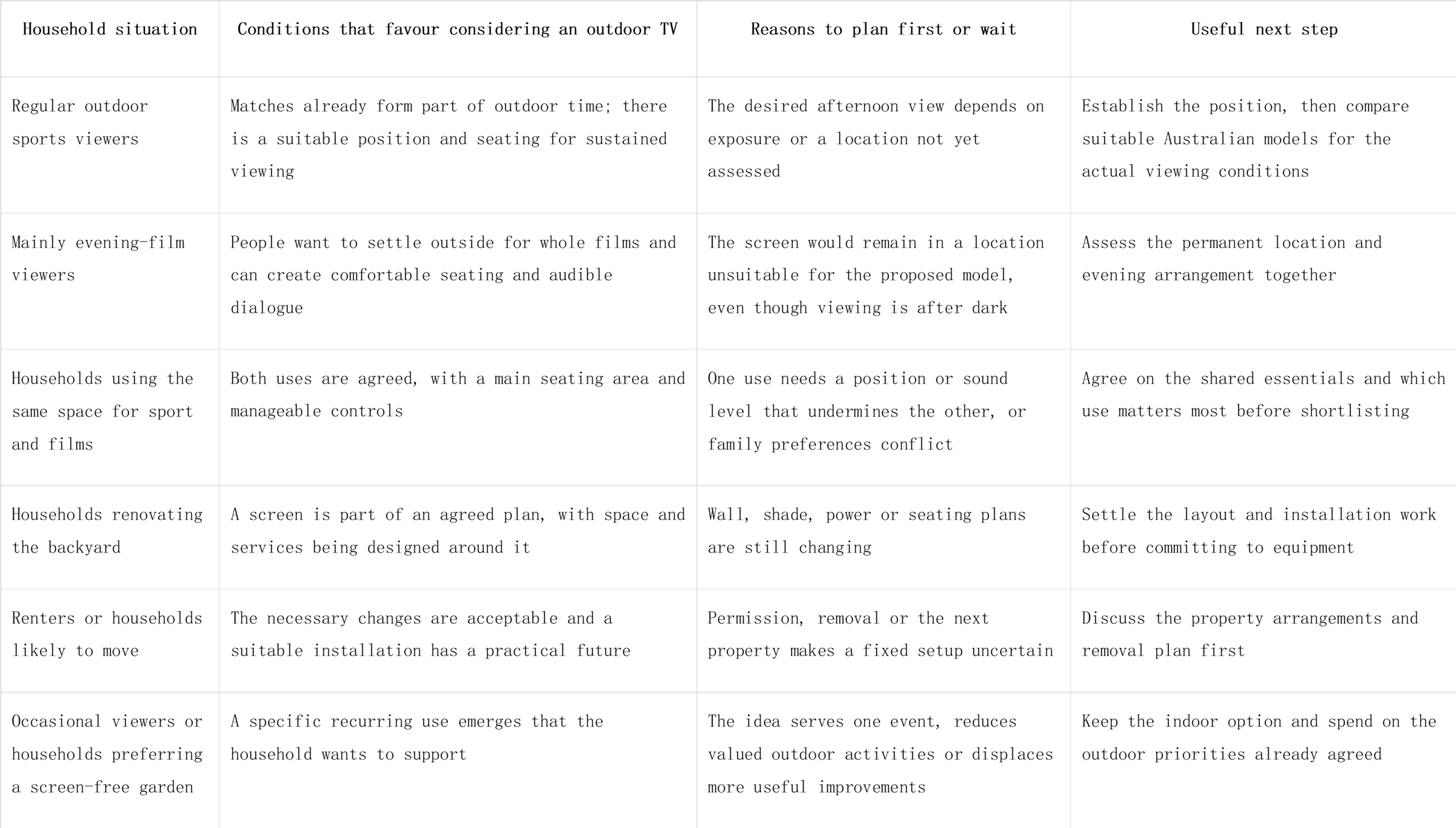
The table is a planning aid, not a ranking of household types or products. It also gives a way to spot the decision that comes first. A family may be ready to choose seating or seek an installation quote even when it is not ready to choose a television.
For example, a household may watch films outside every weekend and still be unable to make the changes needed at a rental property. Read the film row for its viewing needs, but let the property restriction determine the next action. If there is no suitable permitted arrangement, frequent use alone is not a reason to buy. By contrast, owners renovating an alfresco may have permission and budget but an unsettled layout; their next step is to finish that plan. These examples show why a household can meet one row’s favourable conditions and still need to wait.
Choose the next step that fits this summer
Consider an outdoor TV now if the household agrees on its use, has a suitable location and can complete the arrangement within its budget. At that point, shortlisting models available in Australia is a concrete next step: the comparison has a known setting, audience and purpose.
Plan first if the desire to watch outside is clear but the location or infrastructure is unresolved. Depending on the obstacle, that might mean finalising a wall position, arranging shade, obtaining a quote for necessary work or establishing the playback route. Put those decisions in order so an equipment purchase does not dictate an unfinished renovation.
Wait if the household expects very little use, prefers to keep the outdoor space free of a screen or would struggle to fund the necessary setup. An outdoor TV is one possible addition to summer life. Comfortable seating, shade or simply keeping the current indoor viewing arrangement may better serve the household’s immediate plans.
Before shopping, have a short conversation with everyone who uses the space. Name the activity the TV would support, identify the biggest unresolved obstacle and agree on the next action. If the answers point to improving the space first, do that. If they point to a suitable, useful viewing area, compare equipment against that plan.
The worthwhile purchase is the one that fits how the household wants to spend its summer, including the time when the screen is switched off.


